MAONO P2 Hybrid USB Audio vs MAONO P1 USB Audio Interface (2026): Key Differences
As an Amazon Associate we earn from qualifying purchases. Links on this page are affiliate links.
When comparing the maono p2 hybrid USB audio vs p1 USB audio interface, you see two tools built for creators who need mobile and desktop flexibility. Both units offer dual USB ports with MFi certification and support 24-bit/192kHz recording. They share the same -130dB EIN for silent operation and include the ProStudio 2 software. The main difference lies in gain power and physical design. The P1 provides higher gain for dynamic mics, while the P2 offers dual XLR inputs for greater input variety.
Key differences
| Aspect | MAONO P2 Hybrid USB Audio Interface | MAONO P1 USB Audio Interface |
|---|---|---|
| Microphone Inputs | Dual XLR | Not listed |
| Maximum Gain | 56dB | 70dB |
| Housing Material | Aluminum-alloy | Zinc-alloy |
| Dimensions (Length) | 6.42 inches | 5.9 inches |
| Gain Control Feature | Independent mute | Auto-Gain |
Which one should you choose?
Choose MAONO P2 Hybrid USB Audio Interface if
- You need to connect two XLR microphones simultaneously for dual-source recording.
- You prefer a slightly larger chassis with an aluminum-alloy build.
- You want independent mute controls for both headphones and monitors.
Choose MAONO P1 USB Audio Interface if
- You use dynamic microphones that require higher gain to drive them effectively.
- You want an Auto-Gain feature to set ideal levels automatically in OBS Studio.
- You prefer a more compact device with a zinc-alloy housing.
Verdict: Choose the P2 if your workflow requires dual XLR inputs for recording multiple sources at once. Select the P1 if you rely on dynamic microphones and benefit from the higher 70dB gain and Auto-Gain automation. Both units deliver the same core connectivity and software ecosystem for mobile and desktop creators.
P2 vs P1 Spec Comparison
Gain Capability
The MAONO P1 offers up to 70dB of gain, which is designed to drive dynamic microphones without needing an external booster. This makes it suitable for microphones that require more power to capture sound clearly. The MAONO P2 provides 56dB of gain. While this is sufficient for most condenser and dynamic microphones, it is lower than the P1’s maximum output. If you use high-impedance or low-output dynamic mics, the P1’s higher gain specification gives you more headroom to set levels without adding noise. Both units share the same -130dB EIN for low noise floor.
Physical Dimensions
The MAONO P2 measures 8.27 inches in width, 6.42 inches in length, and 3.23 inches in height. It weighs 1.1 pounds. The MAONO P1 is smaller, measuring 5.98 inches in width, 5.9 inches in length, and 3.46 inches in height. The P2 is wider and longer, taking up more desk space. The P1 is more compact, which may be better for small mobile setups or tight workspaces. Both feature a 15-degree tilt angle for ergonomic control access. The P2’s larger chassis may accommodate more internal components, while the P1 prioritizes a smaller footprint for portability.
Auto-Gain Feature
The MAONO P1 includes an Auto-Gain feature that sets the ideal microphone level for clear voice capture in OBS Studio. This eliminates the need for manual gain adjustments during streaming or recording. The MAONO P2 does not list Auto-Gain in its specifications. Instead, it relies on independent mute controls and real-time signal indicators to help you track input levels and avoid clipping. If you want automatic level management to simplify your workflow, the P1 is the better choice. The P2 requires you to manually adjust gain settings.
Build Material
The MAONO P2 is built with a durable aluminum-alloy housing. This material is known for being lightweight yet strong, offering good protection for daily use. The MAONO P1 features a rugged zinc-alloy metal housing. Zinc alloy is typically denser and heavier than aluminum, potentially offering different durability characteristics. Both materials provide a professional appearance and robust construction for home studios. The choice between aluminum and zinc alloy depends on your preference for weight and specific material properties, but both ensure a sturdy device for content creation.
LED Indicators
The MAONO P2 uses real-time signal indicators to help you track input levels and avoid clipping. These indicators show when your audio is reaching optimal levels. The MAONO P1 features dynamic LED indicators that provide instant visual feedback to prevent clipping. Both interfaces include visual cues to help you maintain clean recordings. The P1’s indicators are described as dynamic, suggesting they may react more actively to signal changes. The P2’s indicators focus on tracking input levels. Both serve the same practical purpose of helping you monitor audio quality during recording.
Choose the right MAONO interface for you
Users with dynamic microphones needing high gain
The MAONO P1 provides up to 70dB of gain. This specification helps drive dynamic microphones without external boosters. If you use microphones that require more power, this unit handles them flawlessly. The Auto-Gain feature in PROSTUDIO2 software further simplifies capturing clear voice levels in OBS Studio, removing the need for manual adjustments during your sessions.
Podcasters and guitarists using condenser mics
The MAONO P2 features dual XLR inputs with 56dB gain. This setup is compatible with most condenser and dynamic microphones, making it ideal for capturing guitar and vocal nuances. The independent mute controls allow you to prevent unwanted noise during instrument changes. This flexibility supports creators who switch between voiceovers and musical instruments regularly.
Creators who need dual XLR connectivity
The MAONO P2 includes dual XLR inputs, offering more connection options for professional microphones. This hardware configuration supports simultaneous recording of different sources. The 56dB gain is sufficient for most studio-grade condenser and dynamic microphones. If your workflow relies on multiple XLR devices, this interface provides the necessary ports and signal clarity for your content creation.
The products compared

MAONO P2 Hybrid USB Audio Interface
Best for: Simultaneous mobile and desktop recording
- Connectivity
- USB Audio Interface, USB, XLR
- Dimensions
- 6.42 × 8.27 × 3.23 inches
- Weight
- 1.1 pounds
View on Amazon: MAONO P2 Hybrid USB Audio Interface Affiliate link
The MAONO P2 is a dual XLR audio interface with hybrid USB connectivity for PC, phone, and iPad. It records at 24-bit/192kHz with 56dB gain and -130dB EIN. Independent mute controls and ASIO support reduce latency. The aluminum-alloy housing measures 8.27 by 6.42 inches. It suits creators needing simultaneous mobile and desktop recording.
Pros
- Dual XLR inputs with 56dB gain
- Hybrid USB-C connectivity for PC and mobile
- 24-bit/192kHz recording resolution
- -130dB EIN for low noise
- ASIO support for low-latency monitoring
Cons
- No Bluetooth connectivity listed
- No dedicated display screen
- 56dB gain is lower than the P1's 70dB
Good fit if
- You need to record from both a computer and a mobile device simultaneously
- You require dual XLR inputs for microphones
- You want low-latency monitoring via ASIO
Skip if
- You need higher gain than 56dB
- You require Bluetooth wireless connectivity
- You prefer a device with a built-in display
Verdict: MAONO P2 Hybrid USB Audio Interface fits creators who need simultaneous mobile and desktop recording with dual XLR inputs. It is less suitable if you need higher gain than 56dB or wireless Bluetooth connectivity.
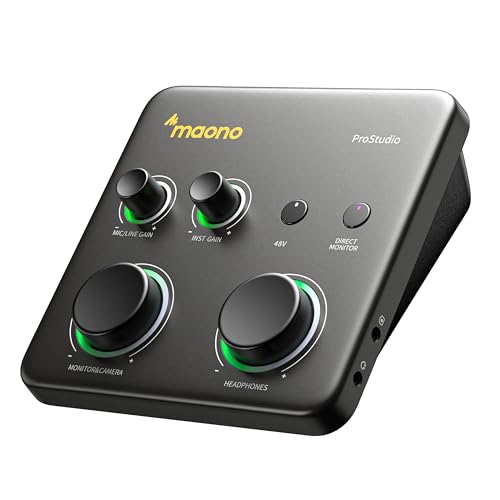
MAONO P1 USB Audio Interface
Best for: Hybrid USB recording with high gain
- Connectivity
- USB Audio Interface, USB
- Intended Use
- Recording, Streaming
- Dimensions
- 5.9 × 5.98 × 3.46 inches
View on Amazon: MAONO P1 USB Audio Interface Affiliate link
The MAONO P1 is a compact USB audio interface designed for creators who need hybrid connectivity. It features dual USB ports for simultaneous computer and mobile device connections. The unit offers up to 70dB gain and 24-bit/192kHz recording quality. Its zinc-alloy housing provides durability in a small footprint. This interface suits podcasters and musicians seeking low-latency monitoring and straightforward routing for streaming or recording.
Pros
- Dual USB ports enable simultaneous connection to PC and mobile devices
- Up to 70dB gain handles dynamic microphones without external boosters
- 24-bit/192kHz resolution ensures high-fidelity audio capture
- Zinc-alloy metal housing offers durable construction
Cons
- No Bluetooth connectivity for wireless audio transmission
- Lacks a built-in display for visual level monitoring
- Physical dimensions are larger than some pocket-sized competitors
Good fit if
- You need to record from both a computer and a mobile device simultaneously
- You require high gain for dynamic microphones or guitars
- You want a durable metal build for a home studio
Skip if
- You require Bluetooth connectivity for wireless operation
- You need a built-in display for visual feedback
- You prefer a significantly smaller footprint for travel
Verdict: The MAONO P1 USB Audio Interface is a robust choice for creators who need hybrid USB connectivity and high gain for dynamic instruments. It fits users who prioritize durable construction and simultaneous multi-device recording over wireless features.
Specifications side by side
| Spec | MAONO P2 Hybrid USB Audio Interface | MAONO P1 USB Audio Interface |
|---|---|---|
| Connectivity | USB Audio Interface, USB, XLR | USB Audio Interface, USB |
| Intended Use | not stated | Recording, Streaming |
| Dimensions | 6.42 × 8.27 × 3.23 inches | 5.9 × 5.98 × 3.46 inches |
| Weight | 1.1 pounds | not stated |
| Model | P2 | P1 |
Frequently asked questions
Which interface is better for podcasters recording on both phones and computers?
The MAONO P2 Hybrid USB Audio Interface is the better choice. It is specifically designed for simultaneous mobile and desktop recording. You can connect it to multiple devices at once. This setup allows you to record directly from your phone while monitoring on your computer. It fits creators who need flexibility across different platforms.
Does the MAONO P2 have XLR inputs for professional microphones?
Yes, the MAONO P2 includes dual XLR inputs. This feature allows you to connect professional XLR microphones directly to the unit. It supports hybrid connectivity by combining USB and XLR options. The MAONO P1 does not list XLR connectivity in its specifications. The P2 is the only option here for XLR connections.
How do the physical sizes of the P1 and P2 compare?
The MAONO P2 is larger than the P1. The P2 measures 8.27 inches in width and weighs 1.1 pounds. The P1 is more compact, measuring 5.98 inches in width. It does not list a weight in the provided data. If you need a smaller footprint for your desk, the P1 is the more portable option.
Can I use these interfaces for simultaneous multi-device recording?
Both interfaces support simultaneous multi-device recording. The MAONO P2 is explicitly noted for this capability alongside mobile and desktop use. The MAONO P1 also supports hybrid USB connectivity for multiple devices. This feature lets you record from different sources without switching connections. It is useful for creators who work with various setups.
Which model offers higher gain for dynamic microphones?
The MAONO P1 offers higher gain capability. It provides up to 70dB of gain. This specification helps drive dynamic microphones without needing an external booster. The P2 has a lower gain limit of 56dB. If your microphones require more power to capture sound clearly, the P1 is the stronger choice.
Are both interfaces certified for use with Apple devices?
Yes, both units feature dual USB ports with MFi certification. This means they are certified for use with Apple devices. You can connect them to iPhones or iPads directly. This certification ensures compatibility and stable performance. It allows you to use either interface for mobile recording on Apple hardware without issues.