Mixer Type Explained: What It Means for Dj Controllers
As an Amazon Associate we earn from qualifying purchases. Links on this page are affiliate links.
Mixer Type Explained For Controllers
The mixer type explained reveals how a DJ controller processes audio signals. This spec defines the internal architecture of the mixing section. You will typically see two main categories: digital and analog. Understanding this distinction helps you choose gear that fits your workflow.
Digital mixers use signal processing chips to handle audio. These chips convert sound waves into binary data. The controller manipulates this data using algorithms. This approach allows for precise control over equalization and effects. Many modern controllers rely on this technology. It enables features like hot cues, loops, and real-time effects without external hardware. The signal remains digital until it reaches the output stage. This reduces noise and interference during transmission.
Analog mixers process audio through physical electronic components. Resistors, capacitors, and transistors shape the sound wave directly. This method is traditional and widely used in professional setups. Analog circuits provide a continuous voltage representation of the audio. Some users prefer this for its perceived warmth. However, digital converters are now highly accurate. The difference in sound quality is often negligible for most applications.
When shopping, check the specifications for the mixer type. Listings usually state whether the unit uses a digital or analog path. Some hybrid models combine both approaches. They may use analog preamps with digital processing later in the chain. This configuration offers flexibility. You can route signals differently based on your needs.
Why does this matter to you? It affects latency, sound quality, and feature availability. Digital mixers often support more complex routing options. Analog mixers may offer simpler, more tactile control. Consider your primary use case. If you need extensive software integration, a digital path is standard. If you prioritize direct hardware manipulation, an analog circuit might appeal to you. Review the spec sheet carefully to confirm the architecture before purchasing.
Digital vs Analog Mixer Types
Digital
Digital mixers route audio signals through internal processors. This architecture allows for precise control and built-in effects. You get features like DSP and MP3 playback without external gear. The Pyle 10-Channel model shows this versatility. It includes USB and Bluetooth connectivity for modern setups. This type suits users who need versatile input options and studio recording capabilities. It is not designed for DJ-specific workflows requiring software integration. Digital units often offer more channels in a compact form. However, they may lack the tactile immediacy of hardware knobs. You rely on digital interfaces for adjustments.
Analog
Analog mixers process audio signals through physical circuitry. This path provides a direct signal flow without digital conversion. You experience tactile control via physical faders and rotary pots. The Headliner 4-Channel Analog Rotary Mixer highlights this approach. It uses ALPS rotary pots for isolator EQs and dual-mode filtering. This type fits DJs who connect multiple turntables and prioritize rotary leveling. It is suitable for multi-channel analog studio recording. Analog gear often offers ASIO support for low latency. The trade-off is fewer built-in digital effects. You may need external processors for advanced sound shaping. The signal path remains purely hardware-based throughout.
Is This Spec Worth Your Attention
Who needs it
You should prioritize this specification if your workflow relies heavily on integrated signal processing. Digital mixer architectures handle effects, EQ, and routing internally through digital signal processors. This setup is ideal for producers or performers who need precise control over audio manipulation without external hardware. If you value built-in features like MP3 playback or USB connectivity within the mixing stage, this spec is critical. It ensures that your audio path is managed by the controller’s core logic. This choice benefits those who want a streamlined signal chain. You avoid the need for separate processors. The internal routing defines how clean or colored your sound becomes. For users who depend on specific digital effects chains, understanding the mixer type helps you select gear that matches your technical requirements. It impacts your creative options directly.
Who can skip it
You can ignore this detail if you primarily use external hardware for mixing. Many DJs connect their controllers to standalone mixers or CDJs. In these setups, the controller acts mainly as a transport and MIDI device. The internal mixer architecture becomes irrelevant because you are not using its signal path. Instead, focus on connectivity options like USB-MIDI stability or pad responsiveness. If you value tactile control over physical knobs and faders, look for controllers with high-quality mechanical components. Prioritize build quality and latency specifications. These factors affect your performance more than the internal signal type. You should also consider compatibility with your existing software. The mixer type does not change how your software behaves. It only changes how the hardware processes signals locally. For most standard setups, this spec is a minor detail.
Mixer Type Glossary
Digital Signal Processor
An internal chip that handles audio effects and mixing. It allows precise control over sound without external hardware. You find this in most modern controllers.
Analog Circuitry
Physical electronic components that process audio waves. It offers a traditional signal path. This type is less common in compact DJ gear today.
Input Channels
Ports where you connect audio sources. Each channel handles one deck or microphone. More channels allow for complex live setups.
USB Connectivity
A standard interface for data and power. It connects your controller to your computer. Most digital mixers use this for communication.
DSP Effects
Audio modifications handled by digital processors. These include reverb, delay, and filters. They integrate directly into the mixer’s signal chain.
Form Factor
The physical size and layout of the unit. It determines portability and desk space. Compact models suit mobile DJs; larger ones offer more controls.
Deck Style
The layout of transport controls and jog wheels. It mimics turntables or CDJs. This style influences how you cue and mix tracks.
System Type
The overall architecture of the mixer’s design. It defines how signals flow through the unit. This affects latency and audio quality.
Quick picks
| # | Product | Best for | Price |
|---|---|---|---|
| 1 | Pyle 10-Channel Bluetooth Audio Mixer | Live events and studio recording sessions | Check price of Pyle 10-Channel Bluetooth Audio Mixer on Amazon |
| 2 | Donner 10-Channel Analog Mixer | multi-channel analog studio recording | Check price of Donner 10-Channel Analog Mixer on Amazon |
| 3 | Allen & Heath CQ Digital Stage Box Mixer | Multitrack studio recording needing high channel counts | Check price of Allen & Heath CQ Digital Stage Box Mixer on Amazon |
| 4 | Headliner R4 4-Channel Analog Rotary Mixer | analog setups needing four-channel rotary control | Check price of Headliner R4 4-Channel Analog Rotary Mixer on Amazon |
| 5 | MIZISNR 8-Channel Digital Audio Mixer | Multi-channel digital mixing with effects | Check price of MIZISNR 8-Channel Digital Audio Mixer on Amazon |
| 6 | Arturia 88-Key Weighted USB Controller | studio producers needing full-size keys | Check price of Arturia 88-Key Weighted USB Controller on Amazon |
Our 6 picks

Pyle 10-Channel Bluetooth Audio Mixer
Best for: Live events and studio recording sessions
- Mixer Type
- Digital (what this guide is about)
- Channels
- 10-channel
- Connectivity
- Bluetooth, USB, XLR
- Features
- Effects, MP3 Player
- Intended Use
- Recording
- Included Accessories
- Microphone
View on Amazon: Pyle 10-Channel Bluetooth Audio Mixer Affiliate link
This 10-channel digital mixer from Pyle offers XLR, 1/4", and RCA inputs for versatile connectivity. It includes DSP effects like echo and reverb, plus Bluetooth 5.0 and USB recording. The LED display shows level indicators and track info. With phantom power and low-cut switches, it suits studio sessions or live events. Its compact size fits desktops or stages.
Pros
- 10-channel configuration with XLR, 1/4", and RCA inputs
- DSP effects including echo, reverb, and delay
- Bluetooth 5.0 and USB MP3/WAV playback
- LED digital display with visual level indicators
- +48V phantom power and low-cut switches
Cons
- No dedicated DJ software integration mentioned
- No built-in crossfader for DJ transitions
- Includes a microphone but no stand or mount
Good fit if
- You need a digital mixer with Bluetooth streaming
- You want DSP effects for vocal processing
- You require phantom power for studio microphones
Skip if
- You need a dedicated DJ controller with crossfader
- You require native software integration for mixing
- You prefer analog-only signal paths
Verdict: Pyle 10-Channel Digital Audio Mixer fits users who need versatile input options and DSP effects for live or studio use. It is not designed for DJ-specific workflows requiring software integration.

Donner 10-Channel Analog Mixer
Best for: multi-channel analog studio recording
- Mixer Type
- Analog (what this guide is about)
- Channels
- 10-Channel
- Features
- 48V Phantom Power
- Included Accessories
- Microphone
View on Amazon: Donner 10-Channel Analog Mixer Affiliate link
The Donner DAM-1000 is a 10-channel analog mixer designed for studio recording and live streaming. It features BT 5.3 wireless connectivity and built-in reverb and delay effects. The unit includes 48V phantom power and supports ASIO drivers for low-latency DAW integration. With a 105dB signal-to-noise ratio, it offers high-fidelity audio. This mixer suits creators needing multiple inputs and precise signal shaping for professional sound reproduction.
Pros
- 10 input channels for extensive connectivity
- BT 5.3 wireless audio input
- ASIO driver support for low latency
- 48V phantom power included
- Built-in reverb and delay effects
Cons
- Analog-only architecture limits digital integration
- No mention of USB audio interface capability
- Included microphones are not professional grade
Good fit if
- You need multiple channel inputs for live streaming
- You require ASIO driver support for DAWs
- You want built-in wireless audio input
Skip if
- You need a fully digital mixing workflow
- You require a dedicated USB audio interface
- You prefer rotary-only control layouts
Verdict: Donner DAM-1000 10-Channel Analog Mixer fits creators who need high channel counts and ASIO support for studio recording. It is not suitable for users requiring a fully digital signal path or native USB audio streaming.

Allen & Heath CQ Digital Stage Box Mixer
Best for: Multitrack studio recording needing high channel counts
- Mixer Type
- Digital (what this guide is about)
- Channels
- 16 Mic or Line inputs
- Audio Interface
- 24x24 USB interface
- Connectivity
- Bluetooth
- Dimensions
- 17.7 × 10.2 × 9.8 inches
- Weight
- 9.7 pounds
View on Amazon: Allen & Heath CQ Digital Stage Box Mixer Affiliate link
This digital mixer comes in a rack-mountable stage box format for studio setups. You get a built-in 24x24 USB interface and 24x24 SD card recording alongside 16 mic or line inputs and dual stereo line inputs. Built-in dual-band Wi-Fi and Bluetooth handle wireless connections. It suits multi-track studio recording when you need high digital input counts.
Pros
- 24x24 USB audio interface and 24x24 SD card recording
- 16 mic or line inputs with 8 combi connectors
- Dual-band 2.4GHz and 5GHz Wi-Fi with stereo Bluetooth input
- Rack-mountable stage box format weighing 9.7 pounds
Cons
- Stage box design does not include physical mixing faders
- Hardware specifications do not include a built-in display
Good fit if
- You need 24x24 USB connectivity or SD card recording for studio tracking.
- You require 16 mic or line inputs in a rack-mountable digital chassis.
- You want integrated Wi-Fi and Bluetooth wireless routing.
Skip if
- You prefer hardware channel faders and physical control knobs on your console.
- You only require a simple four-channel analog mixer for basic stereo audio.
Verdict: Allen & Heath CQ Digital Stage Box Mixer delivers a 24x24 USB interface and 16 mic inputs in a rack-ready chassis. It suits studio operators who prioritize high digital channel counts and wireless routing over physical faders.

Headliner R4 4-Channel Analog Rotary Mixer
Best for: analog setups needing four-channel rotary control
- Mixer Type
- Analog (what this guide is about)
- Channels
- 4-Channel
- Dimensions
- 12 × 12.2 × 3.35 inches
- Weight
- 10.2 pounds
View on Amazon: Headliner R4 4-Channel Analog Rotary Mixer Affiliate link
This analog DJ mixer provides four stereo channels with dedicated rotary volume knobs and three-band isolator EQs. It gives you balanced XLR and unbalanced RCA master and booth outputs, alongside four line, three phono, and two mic inputs. An analog filter provides high pass and low pass sweeps with resonance control, making it practical if you run an all-analog signal path.
Pros
- Four stereo channels with 3-band isolator EQs
- Analog high-pass and low-pass filter with resonance control
- Balanced XLR and unbalanced RCA outputs for Master and Booth
- Genuine ALPS potentiometers and metal enclosure
Cons
- Built-in effects are limited to a high-pass and low-pass filter
- Provides three phono inputs across four channels
- Total unit weight is 10.2 pounds
Good fit if
- You mix using rotary volume knobs instead of standard faders.
- You need balanced XLR outputs for independent Master and Booth monitoring.
- You connect up to three turntables and four line-level sources.
Skip if
- You need digital effects beyond an analog filter.
- You require four dedicated phono preamps for four simultaneous turntables.
Verdict: Headliner 4-Channel Analog Rotary Mixer delivers tactile analog control with ALPS rotary pots, isolator EQs, and dual-mode analog filtering. It fits DJs who connect multiple turntables and prioritize rotary leveling over digital multi-effects.
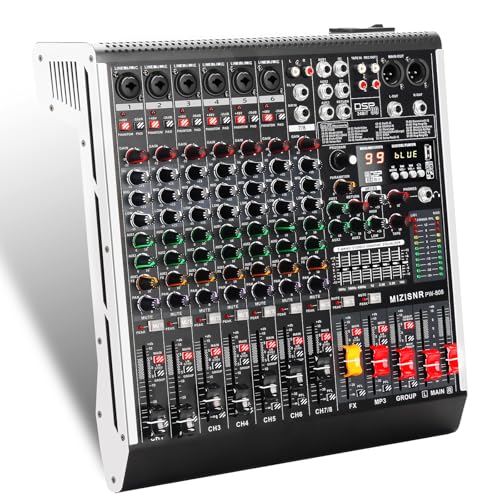
MIZISNR 8-Channel Digital Audio Mixer
Best for: Multi-channel digital mixing with effects
- Mixer Type
- Digital (what this guide is about)
- Channels
- 8 Channel
- Audio Interface
- USB Audio Interface
- Connectivity
- Bluetooth, USB
- Features
- Effects, MP3 Player
- Intended Use
- Professionals, Recording
View on Amazon: MIZISNR 8-Channel Digital Audio Mixer Affiliate link
The MIZISNR PW-808 is an 8-channel digital mixer designed for studio recording and live performance. It features 99 built-in DSP effects and a main output 7-band EQ for precise sound shaping. You get USB and Bluetooth connectivity for direct device pairing. The unit supports phantom power and includes a built-in MP3 player. Its 13.8-inch width offers a compact footprint for your setup.
Pros
- 8-channel mixing with independent GAIN, EQ, AUX, and PAN controls
- 99 built-in DSP effects for versatile sound processing
- Main output 7-band EQ for fine-tuned audio adjustment
- Bluetooth and USB connectivity for direct device input
- +48V phantom power for condenser microphones
Cons
- 7.7-pound weight adds bulk to your transport setup
- No dedicated remote control included in specifications
- Bluetooth range limited to 33 feet
Good fit if
- You need multiple channel inputs for complex recordings
- You want built-in DSP effects without external gear
- You require Bluetooth streaming for live performances
Skip if
- You prefer analog-only signal paths
- You need more than 8 input channels
- You prioritize ultra-lightweight portability
Verdict: The MIZISNR 8-Channel Digital Mixer fits users who need a feature-rich, multi-channel unit with built-in effects and digital connectivity for studio or live use.

Arturia 88-Key Weighted USB Controller
Best for: studio producers needing full-size keys
- Mixer Type
- Analog (what this guide is about)
- Compatible Software
- Analog Lab V
- Performance Pads
- 16 RGB-backlit performance pads
- Connectivity
- USB
- Dimensions
- 50.9 × 12.7 × 4.41 inches
- Weight
- 33.1 pounds
View on Amazon: Arturia 88-Key Weighted USB Controller Affiliate link
The Arturia KeyLab 88 MkII is an 88-key weighted USB MIDI controller. It features a Fatar TP/100LR keybed with aftertouch and velocity sensitivity. You get 16 RGB performance pads and a control bank with 9 faders and 9 knobs. It runs Analog Lab V software. This unit suits producers needing a full piano-style interface for studio work.
Pros
- 88-key Fatar TP/100LR hammer-action keybed
- 16 RGB-backlit performance pads
- Control bank with 9 faders and 9 knobs
- Velocity sensitive and aftertouch keys
Cons
- Heavy at 33.1 pounds
- Large footprint at 50.9 inches long
- Stand not included
Good fit if
- You need a full 88-key piano layout
- You want extensive hardware controls
- You use Analog Lab V software
Skip if
- You need a portable setup
- You prefer a lightweight device
- You do not own a stand
Verdict: Arturia KeyLab 88 MkII 88-Key Controller is a substantial studio tool for producers who require a full-sized weighted keyboard and extensive control options.
Specifications side by side
| Spec | Pyle 10-Channel Bluetooth Audio Mixer | Donner 10-Channel Analog Mixer | Allen & Heath CQ Digital Stage Box Mixer | Headliner R4 4-Channel Analog Rotary Mixer | MIZISNR 8-Channel Digital Audio Mixer | Arturia 88-Key Weighted USB Controller |
|---|---|---|---|---|---|---|
| Channels | 10-channel | not stated | 16 Mic or Line inputs | not stated | 8 Channel | not stated |
| Compatible Software | not stated | not stated | not stated | not stated | not stated | Analog Lab V |
| Performance Pads | not stated | not stated | not stated | not stated | not stated | 16 RGB-backlit performance pads |
| Audio Interface | not stated | not stated | 24x24 USB interface | not stated | USB Audio Interface | not stated |
| Connectivity | Bluetooth, USB, XLR | not stated | Bluetooth | not stated | Bluetooth, USB | USB |
| Features | Effects, MP3 Player | 48V Phantom Power | not stated | not stated | Effects, MP3 Player | Performance Pads |
| Intended Use | Recording | not stated | not stated | not stated | Professionals, Recording | not stated |
| Woofer Size | not stated | not stated | not stated | not stated | 8-Inch | not stated |
| Mixer Type | Digital | Analog | Digital | Analog | Digital | Analog |
| Included Accessories | Microphone | Microphone | not stated | not stated | not stated | not stated |
| Dimensions | 16.5 × 2.9 × 11 inches | not stated | 17.7 × 10.2 × 9.8 inches | 12 × 12.2 × 3.35 inches | 14.6 × 13.8 × 3.93 inches | 50.9 × 12.7 × 4.41 inches |
| Weight | not stated | not stated | 9.7 pounds | 10.2 pounds | 7.7 pounds | 33.1 pounds |
| Size | 10 Channel | not stated | 9.75 | not stated | 8 Channel - 13.8inch | 88 Keys |
| Color | Black | not stated | Clear | not stated | not stated | White Version |
| Model | PMX510 | not stated | AH-CQ20B | HL90120 | PW-808 | Keylab 88 II |
Frequently asked questions
Does a digital mixer type require software integration?
Not necessarily. While many digital controllers connect to DJ software, the mixer type itself describes the signal path. The Pyle 10-Channel model operates as a standalone unit with USB and Bluetooth connectivity. It handles DSP effects internally. You do not need a computer to use its core mixing functions. This makes it suitable for live events where software integration is not required.
What is the main difference between analog and digital mixer types?
The difference lies in how audio signals are processed. Analog mixers use physical circuitry to route and shape sound. The Headliner R4 uses ALPS rotary pots for this tactile control. Digital mixers route signals through internal processors. This allows for features like MP3 playback and digital effects. You choose analog for traditional feel or digital for versatile processing capabilities.
Can a digital mixer handle multiple audio inputs simultaneously?
Yes. Digital mixer types often support high channel counts for complex setups. The Pyle 10-Channel model accepts ten inputs. The Allen & Heath CQ offers 16 mic inputs via its stage box. These units manage multiple sources through digital signal processors. You can route and mix these inputs independently. This capacity suits studio recording or large live events requiring many sources.
Do analog mixer types include built-in digital effects?
Generally, no. Analog mixers rely on physical knobs and switches for EQ and filtering. The Headliner R4 features isolator EQs and analog filters. It does not include digital signal processing for effects like reverb or delay. If you need built-in DSP effects, you should look for a digital mixer type. The MIZISNR 8-Channel unit includes effects for this purpose.
Is phantom power available on analog mixer types?
It depends on the specific model. Many analog mixers include 48V phantom power for condenser microphones. The Donner 10-Channel Analog Mixer explicitly lists this feature. It supports ASIO for studio recording. This power allows you to use professional microphones directly. You should check the attributes for 48V Phantom Power if you rely on condenser mics.
What connectivity options do digital mixer types typically offer?
Digital mixers often provide versatile connectivity for modern workflows. The Pyle 10-Channel model offers Bluetooth, USB, and XLR connections. The MIZISNR 8-Channel unit also includes Bluetooth and USB. These options allow you to connect to computers, speakers, or mobile devices. You can stream audio or record directly. This flexibility supports both studio and live performance environments.
Which mixer type is better for studio recording?
Both types work, but they serve different needs. Analog mixers like the Donner 10-Channel offer direct signal paths and ASIO support. They suit creators needing high channel counts with traditional control. Digital mixers like the Allen & Heath CQ provide 24x24 USB interfaces. They suit operators prioritizing wireless routing and high digital channel counts. Your choice depends on whether you prefer tactile analog control or digital flexibility.