Digital vs Analog DJ Mixers in 2026: Key Differences
As an Amazon Associate we earn from qualifying purchases. Links on this page are affiliate links.
Choosing between a digital vs analog audio mixer depends on your signal path and workflow needs. Both the Pyle PMX508 and Mackie ProFX6v3 offer multi-channel mixing for live events or studio recording. They share USB connectivity for computer interfacing and built-in digital effects. The main difference lies in their core architecture. The Pyle uses a digital signal processing system with wireless streaming. The Mackie relies on traditional analog circuitry with high-gain preamps for clean signal capture.
Key differences
| Aspect | Pyle PMX508 8-Channel Bluetooth Mixer | Mackie 6-Channel Analog USB Mixer |
|---|---|---|
| Mixer Type | Digital | Analog |
| Channel Count | 8 | 6 |
| Connectivity | Bluetooth, USB, XLR | USB |
| USB Audio Interface | not listed | 2x4 USB I/O |
| Effects | DSP (Echo, Reverb, Delay) | 24 FX Options |
Which one should you choose?
Choose Pyle PMX508 8-Channel Bluetooth Mixer if
- You need more input channels for multiple microphones or instruments.
- You want wireless Bluetooth streaming for background music or playback.
- You prefer DSP-based effects and visual LED level indicators.
Choose Mackie 6-Channel Analog USB Mixer if
- You require high-gain Onyx preamps for clean vocal or instrument recording.
- You need a 2x4 USB interface for custom computer monitoring mixes.
- You prioritize analog signal path clarity for professional studio work.
Verdict: The Pyle PMX508 suits users who need more channels and wireless connectivity for versatile live or DJ setups. The Mackie ProFX6v3 is better for recording-focused users who value high-gain analog preamps and detailed USB interface routing. Your choice depends on whether you prioritize channel count and wireless features or analog signal quality and recording flexibility.
Digital vs Analog Mixer Specs
system type
The Pyle PMX508 is a digital mixer. It uses digital signal processing for its effects. This allows for precise control over echo, reverb, and delay. The Mackie ProFX6v3 is an analog mixer. It processes audio through physical circuitry. Analog mixers offer a direct signal path. Digital mixers often include more flexible routing options. Your choice depends on whether you prefer the tactile feel of analog or the versatility of digital processing for your specific setup needs.
channels
The Pyle PMX508 provides eight input channels. It includes four XLR combo inputs. This allows you to connect multiple microphones or instruments simultaneously. The Mackie ProFX6v3 offers six channels. It features two Onyx mic preamps with high gain. If you need more inputs for a large live event or band, the Pyle model gives you extra capacity. The Mackie is sufficient for smaller setups or duo performances. Consider your maximum number of simultaneous audio sources.
connectivity
Both mixers support USB connectivity for computer interfacing. The Pyle PMX508 adds Bluetooth 5.0 for wireless streaming. You can play music from phones or tablets directly. It also supports MP3 and WAV files via USB flash drive. The Mackie ProFX6v3 focuses on wired connections. It features a 2x4 USB audio interface for recording. This allows for high-resolution 24-bit/192kHz audio transfer. If wireless convenience is key, the Pyle has an edge. For pure audio interface fidelity, the Mackie is strong.
effects
The Pyle PMX508 includes DSP effects. You can adjust echo, reverb, and delay modes. These are controlled via buttons and the LED display. The Mackie ProFX6v3 offers 24 different FX options. These include reverbs and delays for sound enhancement. The Mackie allows blending between computer output and direct feed. This is useful for monitoring tracks during recording. Both provide built-in effects to enhance your mix. The Pyle focuses on DSP flexibility, while the Mackie offers a broader preset library for quick adjustments.
form factor
The Pyle PMX508 measures 11 inches wide. It is 2.9 inches high and 10.4 inches deep. This makes it a compact desktop unit. The Mackie ProFX6v3 is also compact. It measures 8.4 inches wide. It is 2.9 inches high and 7.5 inches deep. The Mackie is slightly narrower and shallower. This might save space on a crowded DJ table or studio desk. Both are lightweight and durable for stage or studio use. Check your available surface area before deciding.
Which mixer fits your workflow
You need Bluetooth streaming and MP3 playback
The Pyle PMX508 includes Bluetooth 5.0 for wireless audio streaming from smartphones or tablets. It also supports MP3 and WAV files via a USB flash drive. This allows you to play backing tracks or playlists directly through the mixer without needing a connected computer, making setup faster for live events.
You prioritize high-fidelity recording quality
The Mackie ProFX6v3 offers 24-bit/192kHz recording quality for clean audio capture. Its 2x4 USB I/O lets you create two custom mixes on your computer. You can monitor specific tracks during playback while sending the full mix back into the mixer, which is ideal for precise overdubbing and professional content creation.
You want phantom power for studio mics
The Pyle PMX508 provides +48V phantom power for its XLR inputs. This allows you to use condenser microphones that require external power. The unit also features low cut and HI-Z switches, giving you control over signal quality for various instruments and vocal setups in both studio and stage environments.
Quick picks
| # | Product | Best for | Price |
|---|---|---|---|
| 1 | Pyle PMX508 8-Channel Bluetooth Mixer | DJ setups requiring Bluetooth and USB recording | Check price of Pyle PMX508 8-Channel Bluetooth Mixer on Amazon |
| 2 | Mackie 6-Channel Analog USB Mixer | small live sound and home recording | Check price of Mackie 6-Channel Analog USB Mixer on Amazon |
The products compared
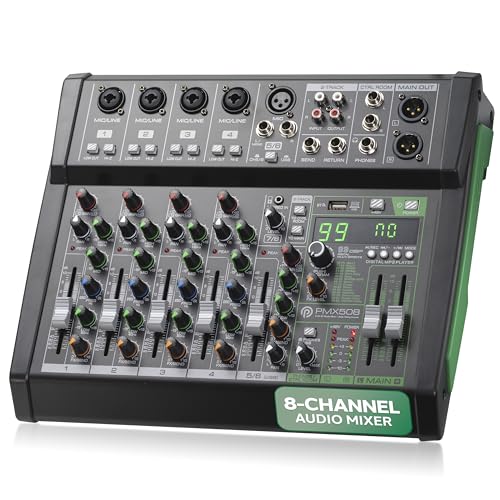
Pyle PMX508 8-Channel Bluetooth Mixer
Best for: DJ setups requiring Bluetooth and USB recording
- Mixer Type
- Digital (what this guide is about)
- Channels
- 8-Channel
- Connectivity
- Bluetooth, USB, XLR
- Features
- Effects, MP3 Player
- Intended Use
- Recording
- Included Accessories
- Microphone
View on Amazon: Pyle PMX508 8-Channel Bluetooth Mixer Affiliate link
The Pyle PMX508 is an 8-channel digital mixer designed for studio recording and live performance. It features four XLR combo inputs with phantom power, Bluetooth 5.0 streaming, and USB connectivity for MP3 playback and PC recording. Built-in DSP effects allow for echo, reverb, and delay adjustments. The unit includes an LED display and stereo level meters for visual monitoring. Its compact 11-inch width makes it suitable for desktop or stage setups.
Pros
- 8-channel configuration with 4 XLR combo inputs
- Built-in DSP effects including echo and reverb
- Bluetooth 5.0 and USB playback/recording support
- +48V phantom power for condenser microphones
Cons
- Digital mixer lacks the tactile workflow of analog gear
- No dedicated faders for channel level control mentioned
- Included microphone may not meet professional standards
Good fit if
- You need Bluetooth streaming for background music
- You require USB recording directly to a PC
- You want DSP effects for vocal processing
Skip if
- You prefer tactile analog faders for mixing
- You need more than 8 input channels
- You require a remote control application
Verdict: Pyle 8-Channel Digital Audio Mixer provides essential digital features and Bluetooth connectivity for DJs needing USB recording. It suits users who prioritize wireless streaming and DSP effects over traditional analog tactile control.

Mackie 6-Channel Analog USB Mixer
Best for: small live sound and home recording
- Mixer Type
- Analog (what this guide is about)
- Channel Count
- 6-channel
- USB Audio Interface
- 2x4 USB I/O
- Built-In Effects
- 24 different FX options
- Connectivity
- Bluetooth, USB
- Features
- Effects
View on Amazon: Mackie 6-Channel Analog USB Mixer Affiliate link
The Mackie ProFX6v3 is a 6-channel analog mixer with USB audio interface capabilities. It features 24 built-in effects and 2x4 USB I/O for recording at 24-bit/192kHz quality. The unit includes two Onyx mic preamps offering 60dB of gain. It supports Bluetooth connectivity and USB. This mixer suits users needing versatile live sound or home recording options with clear audio output.
Pros
- 6-channel analog mixing with 2 Onyx mic preamps
- 2x4 USB I/O for 24-bit/192kHz recording
- 24 built-in FX options including reverbs and delays
- Bluetooth and USB connectivity
Cons
- Analog signal path limits digital integration
- Only 6 input channels available
- No touchscreen interface included
Good fit if
- You need a compact analog mixer for live sound
- You want to record high-quality audio via USB
- You require built-in effects for performance
Skip if
- You require more than 6 input channels
- You need a fully digital mixing workflow
- You prefer a touchscreen control interface
Verdict: The Mackie ProFX6v3 6-Channel Analog Mixer provides reliable analog mixing with USB recording and Bluetooth for small setups. It fits users who prioritize physical controls and straightforward connectivity over digital processing.
Specifications side by side
| Spec | Pyle PMX508 8-Channel Bluetooth Mixer | Mackie 6-Channel Analog USB Mixer |
|---|---|---|
| Channel Count | not stated | 6-channel |
| Mixer Type | not stated | Analog |
| USB Audio Interface | not stated | 2x4 USB I/O |
| Built-In Effects | not stated | 24 different FX options |
| Channels | 8-Channel | 6-Channel |
| Connectivity | Bluetooth, USB, XLR | Bluetooth, USB |
| Features | Effects, MP3 Player | Effects |
| Intended Use | Recording | Professionals |
| Included Accessories | Microphone | Microphone |
| Dimensions | 10.4 × 11 × 2.9 inches | 7.5 × 8.4 × 2.9 inches |
| Weight | not stated | 1 pounds |
| Size | 8 Channel | 16-channel |
| Color | Black | Black |
| Model | PMX508 | ProFX16v3 |
Frequently asked questions
Can I use a digital mixer for live recording?
Yes, digital mixers like the Pyle PMX508 are designed for this purpose. It includes USB connectivity specifically for recording your sets. You can capture high-quality audio directly to a computer or USB drive. This feature makes it ideal for DJs who need to archive their performances or create podcasts.
Does an analog mixer support Bluetooth streaming?
Some analog mixers do support Bluetooth. The Mackie ProFX6v3 is an analog unit that includes Bluetooth connectivity. This allows you to stream music from your phone or tablet directly through the mixer. You get the tactile feel of analog controls with the convenience of wireless audio sources.
Which mixer has more physical channels?
The Pyle PMX508 offers eight input channels. The Mackie ProFX6v3 provides six channels. If you need to connect more microphones or instruments simultaneously, the eight-channel digital option gives you greater capacity. This extra headroom is useful for larger live sound setups or complex DJ configurations.
How do DSP effects differ from analog processing?
Digital mixers use digital signal processing for effects like echo and reverb. The Pyle PMX508 uses this for precise control over sound shaping. Analog mixers process audio through physical circuitry. The Mackie ProFX6v3 relies on this traditional method. DSP often allows for more customizable and repeatable effect settings.
Is USB connectivity standard on both types?
Yes, both mixers feature USB connectivity. The Pyle PMX508 uses USB for recording and MP3 playback. The Mackie ProFX6v3 also includes USB for interfacing with computers. This allows you to route audio to and from your laptop. It is a common feature that bridges analog and digital workflows.
Can I play MP3 files directly from a USB drive?
The Pyle PMX508 supports MP3 and WAV files via a USB flash drive. This lets you play backing tracks or music without a computer. The Mackie ProFX6v3 focuses on mixing and recording. It does not list direct USB media playback as a primary feature. Check your specific model needs.