4-Channel vs 16-Channel DJ Mixers: Which Should You Buy?
As an Amazon Associate we earn from qualifying purchases. Links on this page are affiliate links.
You are looking at a 4-Channel vs 16-Channel audio mixer comparison to find the right gear. Both units support USB connectivity and include built-in digital signal processing for sound shaping. They differ significantly in capacity and physical footprint. The four-channel option is compact and includes 48V phantom power for condenser microphones. The sixteen-channel model offers more inputs and dedicated Onyx preamps for higher gain. You must choose based on your channel count needs and available space.
Key differences
| Aspect | W In-mix 4-Channel USB Audio Mixer | Mackie ProFX16v3 16-Channel USB Mixer |
|---|---|---|
| Channel Count | 4 | 16 |
| Built-In Effects | 256 DSP effects | 24 GigFX effects |
| Phantom Power | 48V | not listed |
| EQ Type | 3-band per channel, 7-band stereo graphic | not listed |
| Preamp Gain | not listed | 60 dB Onyx preamps |
| Dimensions | 12.4 x 10 x 3.74 inches | 4.4 x 17.7 x 17.1 inches |
Which one should you choose?
Choose W In-mix 4-Channel USB Audio Mixer if
- You need to connect four microphones or instruments simultaneously.
- You require 48V phantom power for studio condenser microphones.
- You have limited desk space and need a compact tabletop design.
Choose Mackie ProFX16v3 16-Channel USB Mixer if
- You need to mix sixteen separate audio sources at once.
- You want high-gain Onyx preamps for clean signal capture.
- You plan to record multitrack audio directly to a computer.
Verdict: The W In-mix is better for small setups requiring phantom power and precise graphic EQ. The Mackie ProFX16v3 suits larger productions needing extensive channel count and high-gain preamps. Choose based on your required input count and preamp quality needs.
4-Channel vs 16-Channel Mixer Specs
Channel Count
The W In-mix TC--4 offers four input channels, making it suitable for smaller setups or solo performers who need to mix vocals and instruments. In contrast, the Mackie ProFX16v3 provides sixteen channels, allowing you to connect multiple microphones, instruments, and playback devices simultaneously. This capacity supports larger bands or complex live sound environments where many sources need independent control. If your workflow requires managing many inputs at once, the sixteen-channel option provides the necessary headroom. For simpler configurations, the four-channel unit reduces clutter.
Built-In Effects
The W In-mix TC--4 includes 256 preset DSP effects, covering reverb, delay, and chorus. This extensive library allows for detailed sound shaping without external processors. The Mackie ProFX16v3 features 24 built-in GigFX effects. While fewer in number, these effects are designed for professional studio and live use. The W In-mix offers more variety for creative processing, whereas the Mackie focuses on essential, high-quality effects for quick adjustments. If you need a wide range of presets for different scenarios, the W In-mix has the advantage.
Equalization
Both mixers provide precise control over sound balance. The W In-mix TC--4 features a three-band EQ per channel and a master seven-band stereo graphic EQ. This graphic EQ allows for room tuning and feedback suppression. The Mackie ProFX16v3 includes Onyx preamps with 60 dB of clean gain but does not list a specific graphic EQ configuration in its key specs. The W In-mix offers more detailed frequency control for both individual channels and the master output, giving you surgical precision for live sound adjustments.
Form Factor
Physical size is a major differentiator. The W In-mix TC--4 measures 12.4 inches in height, 10 inches in length, and 3.74 inches in width. It is a compact tabletop unit designed for home studios or small venues. The Mackie ProFX16v3 is significantly larger, measuring 17.7 inches in length, 17.1 inches in width, and 4.4 inches in height, weighing 19.7 pounds. The Mackie requires more desk space and is built for permanent or semi-permanent installations. If space is limited, the W In-mix is the practical choice.
Connectivity
Both units support USB connectivity for recording and playback. The W In-mix TC--4 includes Bluetooth 5.0 for wireless streaming of backing tracks and a USB port for MP3 playback and direct recording. The Mackie ProFX16v3 features a USB audio interface for multitrack recording. While the Mackie supports Bluetooth in some variations, the W In-mix explicitly lists Bluetooth 5.0 as a standard feature. This allows for easy wireless connection to phones or tablets for media playback, adding convenience for mobile DJs or karaoke hosts.
Which DJ Mixer Fits Your Setup
Solo performers needing compact gear
The W In-mix TC--4 measures just 3.74 inches wide, fitting easily into tight spaces like home studios or small venues. Its four channels handle vocals and instruments without clutter. You get 256 DSP effects and Bluetooth streaming, allowing you to mix tracks directly from your phone without a computer. This compact footprint suits mobile DJs who prioritize portability and straightforward setup over extensive channel count.
Live bands requiring many inputs
The Mackie ProFX16v3 provides sixteen channels, enabling you to connect multiple microphones, guitars, and keyboards simultaneously. Its Onyx preamps deliver 60 dB of clean gain for every mic input. You can mix the room sound and record multitrack audio via USB at the same time. This high channel count and robust preamp design make it ideal for bands that need to manage complex live sound setups with professional clarity.
Podcasters needing phantom power
The W In-mix TC--4 includes dedicated 48V phantom power, supporting studio condenser microphones for clear vocal recording. You can record sessions directly to a USB drive without needing an external interface. The built-in MP3 player and Bluetooth 5.0 allow you to stream backing tracks or intro music wirelessly. These features streamline your workflow for podcasting and solo recording, ensuring broadcast-quality audio with minimal equipment.
Users wanting precise EQ control
The W In-mix TC--4 offers a 7-band stereo graphic EQ for room tuning, alongside individual 3-band EQs per channel. This setup gives you surgical precision to shape your sound and tame feedback. The Mackie ProFX16v3 focuses more on channel count and preamp gain. If your priority is detailed frequency adjustment for specific acoustic environments or vocal clarity, the four-channel mixer provides the granular control you need for fine-tuning your mix.
Quick picks
| # | Product | Best for | Price |
|---|---|---|---|
| 1 | W In-mix 4-Channel USB Audio Mixer | Small vocal groups and podcasters | Check price of W In-mix 4-Channel USB Audio Mixer on Amazon |
| 2 | Mackie ProFX16v3 16-Channel USB Mixer | Live bands needing 16 channels | Check price of Mackie ProFX16v3 16-Channel USB Mixer on Amazon |
The products compared

W In-mix 4-Channel USB Audio Mixer
Best for: Small vocal groups and podcasters
- Channels
- 4-Channel (what this guide is about)
- Channel Count
- 4
- Built-In Effects
- 256 DSP effects
- Channel Equalizer
- 3-band EQ, 7-band stereo graphic EQ
- Phantom Power
- 48V
- Connectivity
- Bluetooth, USB
View on Amazon: W In-mix 4-Channel USB Audio Mixer Affiliate link
The W In-Mix 4-Channel Audio Mixer offers four input channels with 48V phantom power for condenser microphones. It includes 256 built-in DSP effects and Bluetooth 5.0 for wireless streaming. The unit features a 7-band stereo graphic EQ for room tuning. This compact mixer suits podcasters and live performers who need USB recording and MP3 playback without a computer.
Pros
- 48V phantom power for studio condenser mics
- 256 preset DSP effects for vocals and instruments
- Bluetooth 5.0 and USB MP3 playback
- 7-band stereo graphic EQ for precise tuning
Cons
- Only 4 input channels limit large ensemble setups
- No dedicated remote control for volume or effects
- No built-in display to show effect parameters
Good fit if
- You need phantom power for condenser microphones
- You want wireless backing tracks via Bluetooth
- You require USB recording without a computer
Skip if
- You need more than 4 input channels
- You require a large display for settings
- You need a remote control for mixing
Verdict: W In-Mix 4-Channel Mixer with Bluetooth is a compact solution for small vocal groups or podcasters who need built-in effects and phantom power. It fits users who prioritize wireless streaming and USB recording over extensive channel counts.
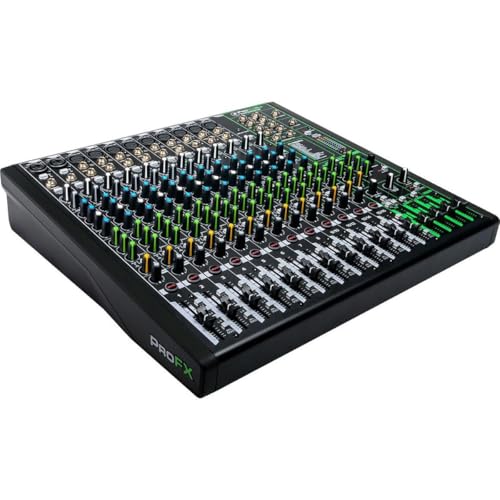
Mackie ProFX16v3 16-Channel USB Mixer
Best for: Live bands needing 16 channels
- Channels
- 16-Channel (what this guide is about)
- Channel Count
- 16-channel
- Mixer Type
- Analog
- USB Audio Interface
- USB recording interface
- Built-In Effects
- 24 built-in effects
- Connectivity
- Bluetooth, USB
View on Amazon: Mackie ProFX16v3 16-Channel USB Mixer Affiliate link
This 16-channel mixer offers 16 inputs for live sound or recording. It includes 60 dB of clean gain on every mic channel and 24 built-in GigFX effects. The USB interface allows multitrack recording while mixing. Its physical footprint is 17.7 by 17.1 inches and weighs 19.7 pounds. It suits venues needing extensive channel count without complex digital workflows.
Pros
- 16 input channels for large setups
- 60 dB clean gain on every mic channel
- 24 built-in GigFX effects
- USB recording interface for multitrack capture
Cons
- Heavy at 19.7 pounds
- Large physical footprint at 17.7 inches wide
- No dedicated display mentioned
Good fit if
- You need 16 channels for live bands
- You want multitrack USB recording
- You prefer analog-style control
Skip if
- You need a portable 4-channel mixer
- You require a lightweight unit
- You want a compact desktop size
Verdict: Mackie ProFX16v3 16-Channel Mixer fits large venues requiring many inputs. It is ideal for live bands needing extensive channel count and multitrack recording capability.
Specifications side by side
| Spec | W In-mix 4-Channel USB Audio Mixer | Mackie ProFX16v3 16-Channel USB Mixer |
|---|---|---|
| Channel Count | 4 | 16-channel |
| Mixer Type | not stated | Analog |
| USB Audio Interface | not stated | USB recording interface |
| Built-In Effects | 256 DSP effects | 24 built-in effects |
| Channel Equalizer | 3-band EQ, 7-band stereo graphic EQ | not stated |
| Phantom Power | 48V | not stated |
| Channels | 4-Channel | 16-Channel |
| Connectivity | Bluetooth, USB | Bluetooth, USB |
| Features | MP3 Player, 48V Phantom Power | Effects |
| Intended Use | Karaoke, Live Performances, Recording | Recording |
| Dimensions | 10 × 3.74 × 12.4 inches | 17.7 × 17.1 × 4.4 inches |
| Weight | not stated | 19.7 pounds |
| Model | TC--4 | 2057323-00 |
| Size | not stated | 16-channel |
| Color | not stated | Black |
Frequently asked questions
Can a 4-channel mixer handle a full live band?
No, a 4-channel mixer is designed for smaller setups like solo performers or small vocal groups. The W In-mix TC--4 is compact and fits users who prioritize wireless streaming and USB recording. It is not suitable for large venues requiring many inputs. For a full band, you need a unit with significantly more channel capacity to accommodate all instruments and microphones simultaneously.
Does the 16-channel option support Bluetooth connectivity?
Yes, the Mackie ProFX16v3 includes Bluetooth connectivity alongside its USB interface. This allows you to stream audio wirelessly from your phone or tablet while recording multitrack sessions. The combination of wireless streaming and extensive channel count makes it ideal for live bands needing both flexibility and high input capacity in a single device.
Is phantom power included on the 4-channel model?
Yes, the W In-mix TC--4 provides 48V phantom power on its channels. This feature is essential for powering condenser microphones used in podcasting or live vocal performances. It ensures you can connect professional audio gear directly without needing external power supplies, making it a practical choice for small groups and content creators.
What is the physical size difference between these mixers?
The W In-mix TC--4 is significantly smaller, measuring 3.74 inches wide by 10 inches long. In contrast, the Mackie ProFX16v3 is much larger at 17.1 inches wide and 17.7 inches long, weighing 19.7 pounds. The 4-channel unit fits easily into tight spaces, while the 16-channel model requires a dedicated studio footprint or stage space.
Can I record multitrack audio with the 16-channel mixer?
Yes, the Mackie ProFX16v3 is designed for multitrack recording capability. Its 16 channels allow you to capture individual inputs from a large ensemble simultaneously. This makes it ideal for live bands needing extensive channel count and detailed audio separation. The USB connection facilitates direct transfer to your computer for editing and production.
Does the 4-channel mixer have built-in effects?
Yes, the W In-mix TC--4 includes built-in digital signal processing for sound shaping. These effects allow you to enhance vocals or instruments during live performances or recordings. The compact design integrates these features without requiring external processors, making it a self-contained solution for karaoke or small group performances.